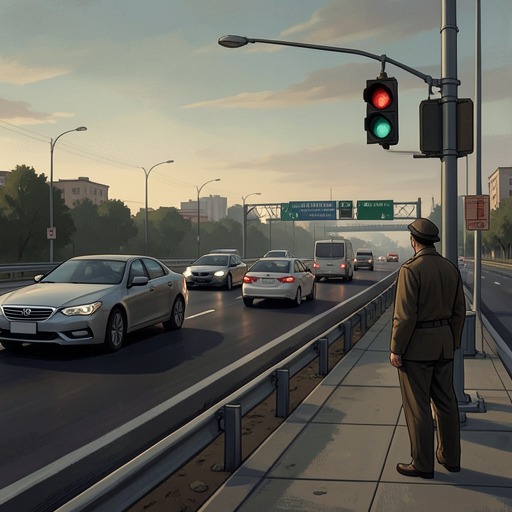
I-15 near San Diego
The Wisdom of CrowdsI-15 near San Diego became a test track for a vision of traffic in which vehicles coordinated rather than reacted independently. In August 1997, researchers from California’s PATH program automated eight Buick LeSabres and drove them in a radio-linked platoon along a seven-and-a-half-mile stretch of the highway. The demonstration showed that vehicles could travel closely together at highway speed without an accident, while also exposing the practical and political obstacles to replacing human control with an engineered system.
The PATH experiment
The researchers equipped the eight LeSabres with steering and gas-pedal controls, motion sensors, radar, and radio communication equipment. The system could transmit information about each car’s speed and acceleration fifty times a second. Automation served two purposes: letting the cars drive themselves and synchronizing a convoy’s speed through radio communication.
The cars traveled just twenty-one feet apart. When one changed speed, the others adjusted immediately, without the delay of human reaction. Over four days, the convoy covered hundreds of miles at sixty-five miles an hour, carrying real passengers without an accident. The result offered a striking contrast to ordinary traffic, where differences in drivers’ speeds and reactions can turn small variations into congestion: here, coordination was built directly into the vehicles’ movements.
A highway redesigned for coordination
The proposed system extended beyond the test vehicles. Dedicated highways would use magnetic markers buried four feet apart so that cars could read the road and remain in the correct lane. Vehicles entering the highway would join platoons and travel together toward their exits, with a platoon potentially assigned to a particular off-ramp.
Such infrastructure would require substantial investment: equipping a highway was estimated to cost at least $10,000 per mile, in addition to the cost of outfitting cars. In return, a smoothly operating automated highway might double or triple capacity and eliminate traffic jams. If that reduced the need to build new highways and the time people spent in gridlock, the costly system might ultimately save money.
Promise and resistance
The experiment made the logic of automation tangible: if variable human driving helps create jams, taking the steering wheel out of drivers’ hands could make traffic flow more smoothly. But a successful demonstration was not the same as a plausible near-term transformation. Drivers might be unwilling to surrender control or entrust their lives to a computer, even though autopilot was already routine in aircraft. Driving, unlike flying, was an activity nearly everyone experienced directly.
The proposal also seemed to depend on government orchestration of how people moved along the highway, a top-down answer at a time when people were more attracted to bottom-up approaches. The test therefore demonstrated both the capacity of tightly synchronized vehicles and the limits of treating coordination as a purely technical problem: the system could organize traffic, but public willingness to accept that organization remained uncertain.